Ash
Fraxinus spp. · Oleaceae · hardwood
Also known as: white ash, European ash, black ash, green ash
Region: Europe, North America and Asia
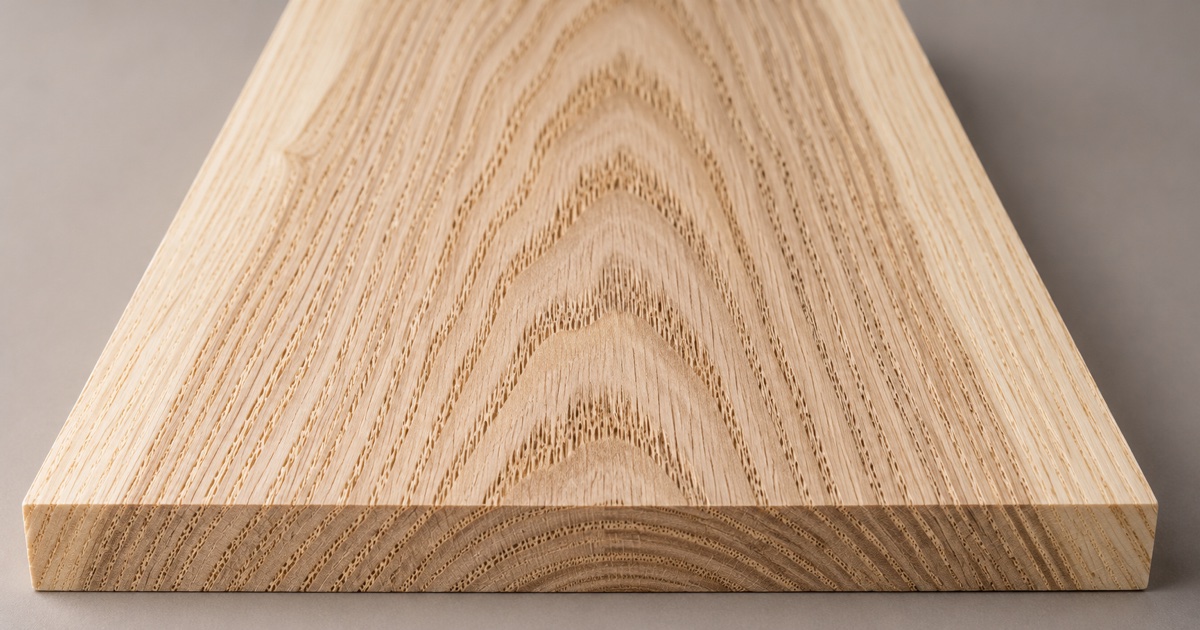
Ash is a tough, springy, ring-porous hardwood with bold grain, prized for tool handles, bats, oars and steam-bent parts as well as furniture and joinery. White ash (Fraxinus americana) and European ash (Fraxinus excelsior) are the main woodworking species.
Health hazards
-
Asthma / respiratory allergy
Evidence: Confirmed in clinical testing
Occupational asthma and rhinitis from ash dust have been confirmed by inhalation challenge in separate cases involving European ash and white ash, and in a third case with a positive skin test to ash wood.123
- Effects
- asthma, rhinitis
- Exposure route
- inhalation
- From
- dust
-
Respiratory irritation
Evidence: Listed by an agency
UK HSE lists reduced lung function among the reported effects of ash dust.4
- Effects
- decreased lung function
- Exposure route
- inhalation
- From
- dust
-
Skin allergy
Evidence: Reported
A case of allergic contact dermatitis to white ash has been described in a woodworker. The testing method was not confirmed from the available abstract.5
- Effects
- allergic contact dermatitis
- Exposure route
- skin
- From
- dust
-
Cancer
Evidence: Applies to all wood dust
IARC classifies all wood dust as carcinogenic to humans, mainly linked to cancer of the nasal cavity and sinuses after long, heavy exposure. This applies to this wood like any other.6
- Effects
- nasal and sinus cancer
- Exposure route
- inhalation
- From
- dust
Not finding a hazard listed here does not mean this wood is safe. All wood dust is hazardous; see how to protect yourself.
Exposure limits
| Body | Limit | Notes |
|---|---|---|
| ACGIH TLV | 1 mg/m³ (inhalable) | 8-hour TWA; ACGIH value as restated by OSHA. source |
| EU binding limit (hardwood) | 2 mg/m³ | Applies to all hardwood dust |
| UK WEL (hardwood) | 3 mg/m³ | Applies to all hardwood dust |
| NIOSH REL | 1 mg/m³ | Recommended limit for all wood dust |
Cancer classifications
- ACGIH: A4 source
Sources
- Fernández-Rivas M, Pérez-Carral C, Senent CJ. Occupational asthma and rhinitis caused by ash (Fraxinus excelsior) wood dust. Allergy. 1997;52(2):196-199. Link
- Malo JL, Cartier A. Occupational asthma caused by exposure to ash wood dust (Fraxinus americana). Eur Respir J. 1989;2(4):385-387. Link
- Szmidt M, Gondorowicz K. [Bronchial asthma caused by exposure to ash wood dust]. Pol Tyg Lek. 1994;49(14-15):343-344. (Article in Polish.) Link
- Health and Safety Executive. Toxic woods. Woodworking Information Sheet No 30 (Revision 1), WIS30(rev1). HSE; first published 11/2012. Withdrawn from hse.gov.uk (404 since c. Jan 2020); archived copy cited. Link
- Scheman AJ, Xu Y, Osborne A. Allergic contact dermatitis to Fraxinus americanus and Macherium acutifolium. Am J Contact Dermat. 1999;10(4):233-235. Link
- IARC Working Group on the Evaluation of Carcinogenic Risks to Humans. Wood Dust and Formaldehyde. IARC Monographs on the Evaluation of Carcinogenic Risks to Humans, Vol. 62. Lyon: International Agency for Research on Cancer; 1995. Link
- US Occupational Safety and Health Administration. Occupational Chemical Database: Wood Dust. Last updated 06/23/2023. Link
Last reviewed .