Australian blackwood
Acacia melanoxylon · Fabaceae · hardwood
Also known as: blackwood, Tasmanian blackwood, blackwood acacia, sally wattle
Region: Southeastern Australia and Tasmania; planted elsewhere
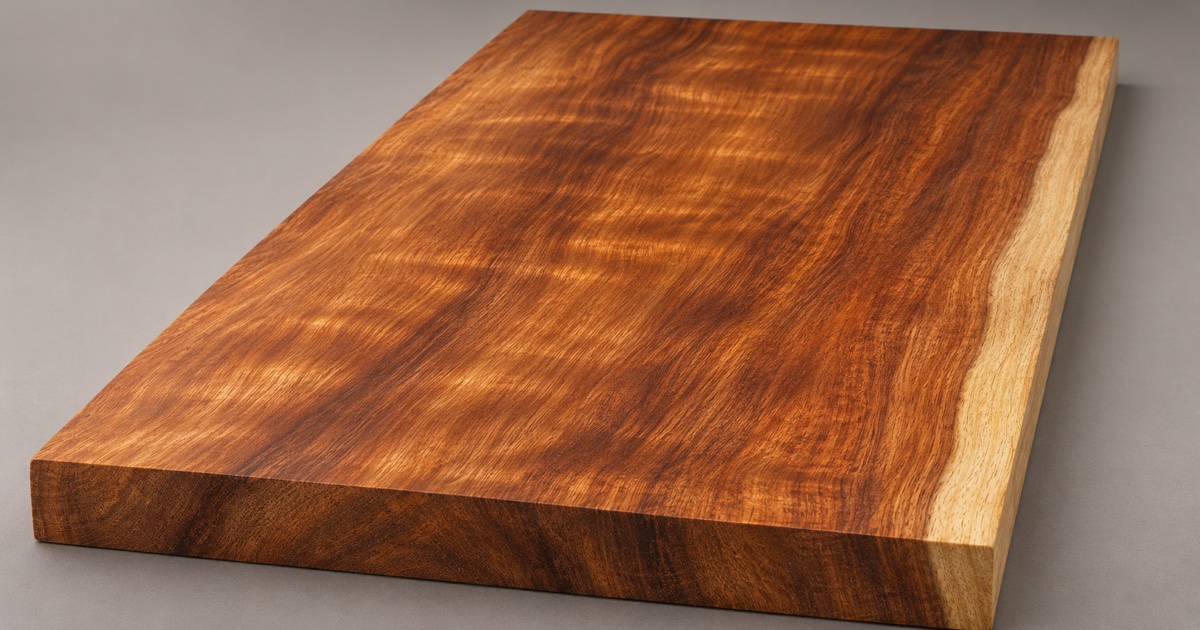
Australian blackwood is a medium-density acacia with golden to dark reddish-brown heartwood, often with striking curly or fiddleback figure. It is used for fine furniture, cabinetry, veneer, and musical instruments such as guitars and ukuleles.
Health hazards
-
Asthma / respiratory allergy
Evidence: Confirmed in clinical testing
Occupational asthma from blackwood dust was reported in Australian woodworkers, and a NIOSH-funded review lists it among woods with a positive specific challenge test.123
- Effects
- asthma
- Exposure route
- inhalation
- From
- dust
-
Skin allergy
Evidence: Reported
Blackwood has long been reported to cause allergic skin rashes in Australian woodworkers. Lab studies identified several heartwood compounds that can sensitize skin, though their individual strength appears modest.456
- Effects
- allergic contact dermatitis
- Exposure route
- skin
- From
- heartwood, dust
-
Cancer
Evidence: Applies to all wood dust
All wood dust, including Australian blackwood, is classified by IARC as carcinogenic to humans, mainly linked to cancers of the nose and sinuses after long-term exposure.7
- Effects
- nasal and sinus cancer
- Exposure route
- inhalation
- From
- dust
Not finding a hazard listed here does not mean this wood is safe. All wood dust is hazardous; see how to protect yourself.
Exposure limits
| Body | Limit | Notes |
|---|---|---|
| ACGIH TLV | 1 mg/m³ (inhalable) | source |
| EU binding limit (hardwood) | 2 mg/m³ | Applies to all hardwood dust |
| UK WEL (hardwood) | 3 mg/m³ | Applies to all hardwood dust |
| NIOSH REL | 1 mg/m³ | Recommended limit for all wood dust |
Cancer classifications
- ACGIH: A4 source
Known compounds
Sources
- Wood-Baker R, Markos J. Occupational asthma due to blackwood (Acacia melanoxylon). Aust N Z J Med. 1997;27(4):452-453. Link
- Michigan State University College of Human Medicine. Occupational Asthma and Wood Dust. Project S.E.N.S.O.R. News. 2017 May;28(3):1-4. Link
- Clarke PS. Allergic reactions to blackwood (Acacia melanoxylon). Med J Aust. 1989;150(4):222-223. Erratum: Med J Aust 1989;150(7):412. Link
- Tilsley DA. Australian blackwood dermatitis. Contact Dermatitis. 1990;23(1):40-41. Link
- Hausen BM, Schmalle H. Quinonoid constituents as contact sensitisers in Australian blackwood (Acacia melanoxylon RBR). Br J Ind Med. 1981;38(2):105-109. Link
- Hausen BM, Bruhn G, Tilsley DA. Contact allergy to Australian blackwood (Acacia melanoxylon R.Br.): isolation and identification of new hydroxyflavan sensitizers. Contact Dermatitis. 1990;23(1):33-39. Link
- IARC Working Group on the Evaluation of Carcinogenic Risks to Humans. Wood Dust and Formaldehyde. IARC Monographs on the Evaluation of Carcinogenic Risks to Humans, Vol. 62. Lyon: International Agency for Research on Cancer; 1995. Link
- US Occupational Safety and Health Administration. Occupational Chemical Database: Wood Dust. Last updated 06/23/2023. Link
Last reviewed .