Brazilian rosewood
Dalbergia nigra · Fabaceae · hardwood
Also known as: Rio rosewood, palisander, Rio palisander, jacaranda, caviuna
Region: Atlantic coastal forest of eastern Brazil
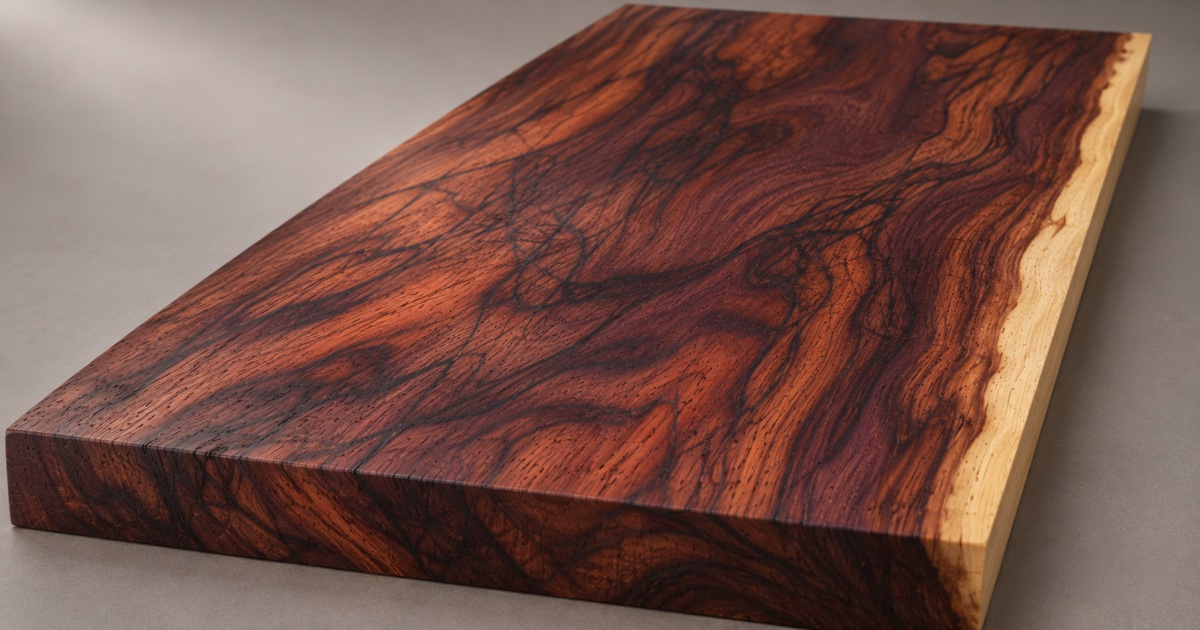
Brazilian rosewood is a dark, richly figured rosewood long used for guitar backs and sides, fine furniture and veneer. It is now heavily restricted in international trade, so most woodworkers meet it as old stock or in musical instruments.
Health hazards
-
Asthma / respiratory allergy
Evidence: Confirmed in clinical testing
A joiner who sanded musical instrument parts developed asthma from palisander (Dalbergia nigra) dust; a skin test and an inhalation challenge with the pure dust confirmed the cause, with a delayed asthmatic reaction.1
- Effects
- occupational asthma
- Exposure route
- inhalation
- From
- dust
-
Skin allergy
Evidence: Reported
Allergic skin rashes have been reported from items made of Brazilian rosewood, such as a bracelet and a wooden cross, and a quinone in the wood was proposed early on as the sensitizer.2345
- Effects
- allergic contact dermatitis
- Exposure route
- skin
- From
- heartwood, dust
-
Skin allergy
Evidence: Listed by an agency
The UK HSE lists rosewoods as a group (many species) as a reported cause of dermatitis, noting that effects can arise just from handling the wood.6
- Effects
- dermatitis
- Exposure route
- skin
- From
- dust, heartwood
-
Respiratory irritation
Evidence: Listed by an agency
The UK HSE also lists rosewoods as a group (many species) as a reported cause of respiratory disorders, without naming a specific mechanism.6
- Effects
- respiratory disorders
- Exposure route
- inhalation
- From
- dust
-
Cancer
Evidence: Applies to all wood dust
All wood dust is classified as carcinogenic to humans, mainly linked to cancers of the nose and sinuses after long-term exposure. This applies to this wood like any other.7
- Effects
- nasal and sinus cancer
- Exposure route
- inhalation
- From
- dust
Not finding a hazard listed here does not mean this wood is safe. All wood dust is hazardous; see how to protect yourself.
Exposure limits
| Body | Limit | Notes |
|---|---|---|
| ACGIH TLV | 1 mg/m³ (inhalable) | Applies to wood dust generally; this species has no separate ACGIH value. source |
| EU binding limit (hardwood) | 2 mg/m³ | Applies to all hardwood dust |
| UK WEL (hardwood) | 3 mg/m³ | Applies to all hardwood dust |
| NIOSH REL | 1 mg/m³ | Recommended limit for all wood dust |
Cancer classifications
- ACGIH: A4 source
Sources
- Godnic-Cvar J, Gomzi M. Case report of occupational asthma due to palisander wood dust and bronchoprovocation challenge by inhalation of pure wood dust from a capsule. Am J Ind Med. 1990;18(5):541-545. Link
- Fisher AA, Bikowski J Jr. Allergic contact dermatitis due to a wooden cross made of Dalbergia nigra. Contact Dermatitis. 1981;7(1):45-46. Link
- Dias M, Vale T. Contact dermatitis from a Dalbergia nigra bracelet. Contact Dermatitis. 1992;26(1):61-62. Link
- Ortiz-Brugues A, Gomez-Martin I, Pujol RM, Rustemeyer T, Gimenez-Arnau A. Non-occupational allergic contact dermatitis to Dalbergia nigra. J Eur Acad Dermatol Venereol. 2016;30(2):335-336. Link
- Schulz KH, Dietrichs HH. Quinone as a sensitizing component of Rio palisander (Dalbergia nigra) and cocobolo (Dalbergia retusa) wood [in German]. Allerg Asthma (Leipz). 1962;8:125-131. Link
- Health and Safety Executive. Toxic woods. Woodworking Information Sheet No 30 (Revision 1), WIS30(rev1). HSE; first published 11/2012. Withdrawn from hse.gov.uk (404 since c. Jan 2020); archived copy cited. Link
- IARC Working Group on the Evaluation of Carcinogenic Risks to Humans. Wood Dust and Formaldehyde. IARC Monographs on the Evaluation of Carcinogenic Risks to Humans, Vol. 62. Lyon: International Agency for Research on Cancer; 1995. Link
- US Occupational Safety and Health Administration. Occupational Chemical Database: Wood Dust. Last updated 06/23/2023. Link
Last reviewed .