Cocobolo
Dalbergia retusa · Fabaceae · hardwood
Also known as: granadillo, palo negro, nambar, cocobolo prieto
Region: Pacific side of Central America, from Panama to southwestern Mexico
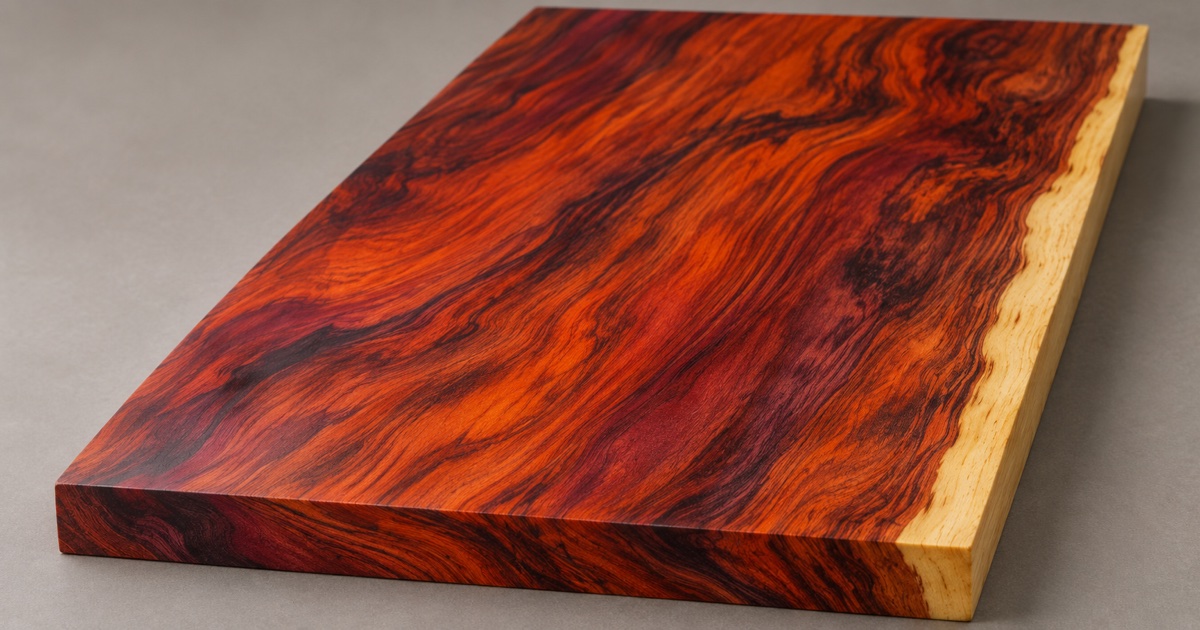
Cocobolo is a very dense, oily Central American rosewood whose heartwood turns deep orange-red with dark streaks. It is prized for knife and tool handles, inlay, turned boxes, pens and musical instruments; its natural oils help it polish well but make gluing harder.
Health hazards
-
Skin allergy
Evidence: Confirmed in clinical testing
Several patch-test-confirmed reports show cocobolo can cause allergic skin rashes in woodworkers and in people using cocobolo items such as recorders and bracelets. In one case a cabinetmaker developed a rash over most of the body after working with the sawdust.12345
- Effects
- allergic contact dermatitis, eczema
- Exposure route
- skin, inhalation
- From
- dust, heartwood
-
Asthma / respiratory allergy
Evidence: Reported
An early report described respiratory allergy, including asthma, in workers exposed to cocobolo dust. We could not confirm what testing was done, so treat this as a reported effect.6
- Effects
- asthma, rhinitis
- Exposure route
- inhalation
- From
- dust
-
Cancer
Evidence: Applies to all wood dust
All wood dust is classified as carcinogenic to humans, mainly linked to cancers of the nose and sinuses after long-term exposure. This applies to this wood like any other.7
- Effects
- nasal and sinus cancer
- Exposure route
- inhalation
- From
- dust
Not finding a hazard listed here does not mean this wood is safe. All wood dust is hazardous; see how to protect yourself.
Exposure limits
| Body | Limit | Notes |
|---|---|---|
| ACGIH TLV | 1 mg/m³ (inhalable) | Applies to wood dust generally; this species has no separate ACGIH value. source |
| EU binding limit (hardwood) | 2 mg/m³ | Applies to all hardwood dust |
| UK WEL (hardwood) | 3 mg/m³ | Applies to all hardwood dust |
| NIOSH REL | 1 mg/m³ | Recommended limit for all wood dust |
Cancer classifications
- ACGIH: A4 source
Known compounds
Sources
- Hausen BM, Munster G. Cocobolo wood, a forgotten eczematogen? Recent findings on the skin allergen of cocobolo wood (Dalbergia sp.) [in German]. Derm Beruf Umwelt. 1983;31(4):110-117. Link
- Guanche AD, Prawer S. Generalized eczematous contact dermatitis from cocobolo wood. Am J Contact Dermat. 2003;14(2):90-92. Link
- Rackett SC, Zug KA. Contact dermatitis to multiple exotic woods. Am J Contact Dermat. 1997;8(2):114-117. Link
- Correale CE, Marks JG Jr. Contact dermatitis in a woodworker. Am J Contact Dermat. 2002;13(1):42-44. Link
- Chudnoff M. Dalbergia retusa (cocobolo). In: Tropical Timbers of the World. USDA Forest Service Agriculture Handbook 607; 1984. Tech sheet hosted by USDA Forest Products Laboratory. Link
- Eaton KK. Respiratory allergy to exotic wood dust. Clin Allergy. 1973;3(3):307-310. Link
- IARC Working Group on the Evaluation of Carcinogenic Risks to Humans. Wood Dust and Formaldehyde. IARC Monographs on the Evaluation of Carcinogenic Risks to Humans, Vol. 62. Lyon: International Agency for Research on Cancer; 1995. Link
- US Occupational Safety and Health Administration. Occupational Chemical Database: Wood Dust. Last updated 06/23/2023. Link
Last reviewed .