African ebony
Diospyros crassiflora · Ebenaceae · hardwood
Also known as: ebony, Gaboon ebony, Cameroon ebony
Region: West and Central Africa
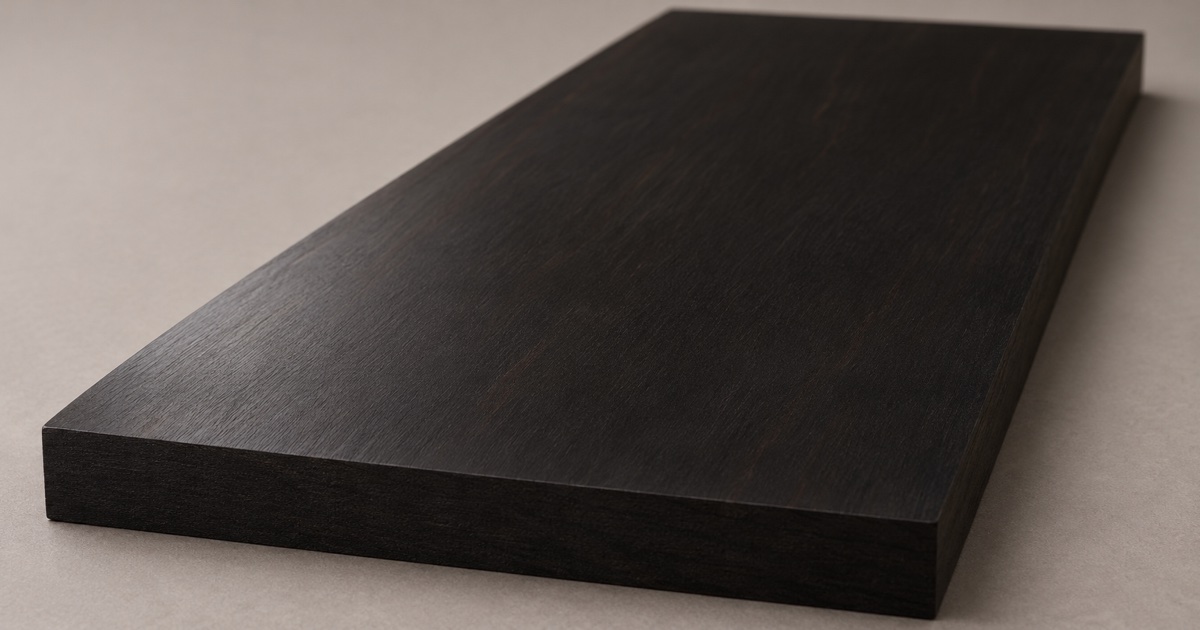
A very heavy, fine-textured hardwood whose heartwood is close to jet black. Prized for small, high-value parts such as instrument fingerboards and fittings, knife and tool handles, inlay, and turned details.
Health hazards
-
Asthma / respiratory allergy
Evidence: Confirmed in clinical testing
Occupational asthma from ebony dust has been confirmed by inhalation challenge, once in a worker exposed to Diospyros crassiflora and once in a violin maker sanding ebony fingerboards. Skin testing was negative in the first case, so the mechanism is not known.12
- Effects
- asthma
- Exposure route
- inhalation
- From
- dust
-
Skin allergy
Evidence: Listed by an agency
The UK HSE lists ebony as a cause of dermatitis and as a possible skin sensitiser. Its listing covers ebony in general rather than naming a particular Diospyros species.3
- Effects
- dermatitis, possible skin sensitization
- Exposure route
- skin
- From
- dust
-
Respiratory irritation
Evidence: Listed by an agency
HSE also lists irritation of the moist linings of the nose, throat and eyes among the reported effects of ebony dust.3
- Effects
- mucous membrane irritation
- Exposure route
- inhalation, eyes
- From
- dust
-
Cancer
Evidence: Applies to all wood dust
IARC classifies all wood dust as carcinogenic to humans, chiefly through cancers of the nose and sinuses. This applies to African ebony dust as it does to any other wood.4
- Effects
- nasal and sinus cancer
- Exposure route
- inhalation
- From
- dust
Not finding a hazard listed here does not mean this wood is safe. All wood dust is hazardous; see how to protect yourself.
Exposure limits
| Body | Limit | Notes |
|---|---|---|
| ACGIH TLV | 1 mg/m³ (inhalable) | source |
| EU binding limit (hardwood) | 2 mg/m³ | Applies to all hardwood dust |
| UK WEL (hardwood) | 3 mg/m³ | Applies to all hardwood dust |
| NIOSH REL | 1 mg/m³ | Recommended limit for all wood dust |
Cancer classifications
- ACGIH: A4 source
Sources
- Maestrelli P, Marcer G, Dal Vecchio L. Occupational asthma due to ebony wood (Diospyros crassiflora) dust. Ann Allergy. 1987;59(5):347-349. Link
- Kopferschmitt-Kubler MC, Bachez P, Bessot JC, Pauli G. [Occupational asthma caused by ebony wood]. Rev Mal Respir. 1992;9(4):470-471. (French) Link
- Health and Safety Executive. Toxic woods. Woodworking Information Sheet No 30 (Revision 1), WIS30(rev1). HSE; first published 11/2012. Withdrawn from hse.gov.uk (404 since c. Jan 2020); archived copy cited. Link
- IARC Working Group on the Evaluation of Carcinogenic Risks to Humans. Wood Dust and Formaldehyde. IARC Monographs on the Evaluation of Carcinogenic Risks to Humans, Vol. 62. Lyon: International Agency for Research on Cancer; 1995. Link
- US Occupational Safety and Health Administration. Occupational Chemical Database: Wood Dust. Last updated 06/23/2023. Link
Last reviewed .