Maple
Acer spp. · Sapindaceae · hardwood
Also known as: hard maple, sugar maple, rock maple, soft maple, red maple, sycamore maple, spalted maple, Acer
Region: Northern Hemisphere; main lumber species from eastern North America and Europe
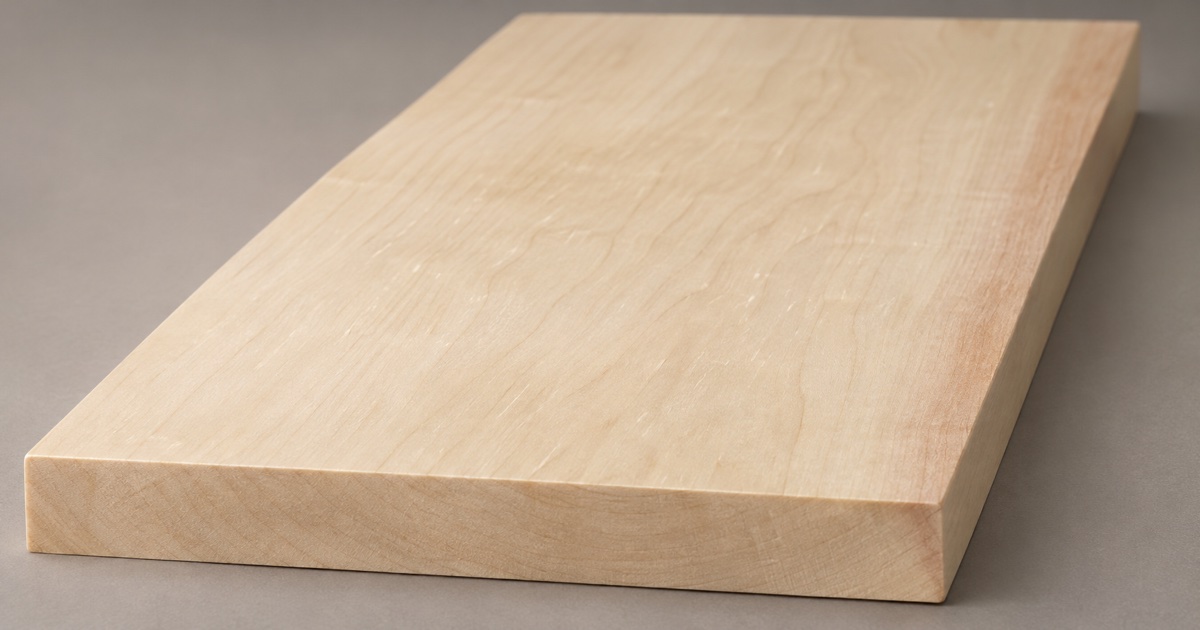
Maple is a pale, dense, fine-grained hardwood sold as hard maple (mainly sugar maple, Acer saccharum) and soft maple (such as red maple, Acer rubrum). It is used for flooring, cutting boards, furniture, butcher blocks, instruments, and turning, and fungus-stained 'spalted' maple is popular with turners.
Health hazards
-
Cancer
Evidence: Applies to all wood dust
IARC classifies all wood dust as carcinogenic to humans, mainly linked to cancer of the nasal cavity and sinuses after long-term heavy exposure. This applies to every species, so dust control matters whatever you cut.1
- Effects
- nasal and sinus cancer
- Exposure route
- inhalation
- From
- dust
-
Respiratory irritation
Evidence: Listed by an agency
The UK HSE lists a decrease in lung function as a reported effect of maple dust. We did not find a primary study on maple wood dust itself, and the HSE sheet does not say which maple species.2
- Effects
- reduced lung function
- Exposure route
- inhalation
- From
- dust
-
Hypersensitivity pneumonitis
Evidence: Reported
Maple bark disease is a lung inflammation caused by breathing spores of the mold Cryptostroma corticale, which grows under the bark of infected maples (mostly sycamore maple). It comes from the fungus on diseased logs and bark, not from clean maple wood, so it mainly concerns people who fell, debark, or mill infected trees.345
- Effects
- hypersensitivity pneumonitis (maple bark disease), cough, breathlessness, flu-like illness
- Exposure route
- inhalation
- From
- bark
Not finding a hazard listed here does not mean this wood is safe. All wood dust is hazardous; see how to protect yourself.
Exposure limits
| Body | Limit | Notes |
|---|---|---|
| ACGIH TLV | 1 mg/m³ (inhalable) | 8-hour time-weighted average, as restated by OSHA source |
| EU binding limit (hardwood) | 2 mg/m³ | Applies to all hardwood dust |
| UK WEL (hardwood) | 3 mg/m³ | Applies to all hardwood dust |
| NIOSH REL | 1 mg/m³ | Recommended limit for all wood dust |
Cancer classifications
- ACGIH: A4 source
Sources
- IARC Working Group on the Evaluation of Carcinogenic Risks to Humans. Wood Dust and Formaldehyde. IARC Monographs on the Evaluation of Carcinogenic Risks to Humans, Vol. 62. Lyon: International Agency for Research on Cancer; 1995. Link
- Health and Safety Executive. Toxic woods. Woodworking Information Sheet No 30 (Revision 1), WIS30(rev1). HSE; first published 11/2012. Withdrawn from hse.gov.uk (404 since c. Jan 2020); archived copy cited. Link
- Emanuel DA, Wenzel FJ, Lawton BR. Pneumonitis due to Cryptostroma corticale (Maple-bark disease). N Engl J Med. 1966;274(25):1413-8. Link
- Wenzel FJ, Emanuel DA. The epidemiology of maple bark disease. Arch Environ Health. 1967;14(3):385-9. Link
- Kespohl S, Riebesehl J, Grüner J, Raulf M. Impact of climate change on wood and woodworkers-Cryptostroma corticale (sooty bark disease): A risk factor for trees and exposed employees. Front Public Health. 2022;10:973686. Link
- US Occupational Safety and Health Administration. Occupational Chemical Database: Wood Dust. Last updated 06/23/2023. Link
Last reviewed .