Padauk
Pterocarpus soyauxii · Fabaceae · hardwood
Also known as: African padauk, African padouk, barwood, camwood
Region: Central and tropical West Africa
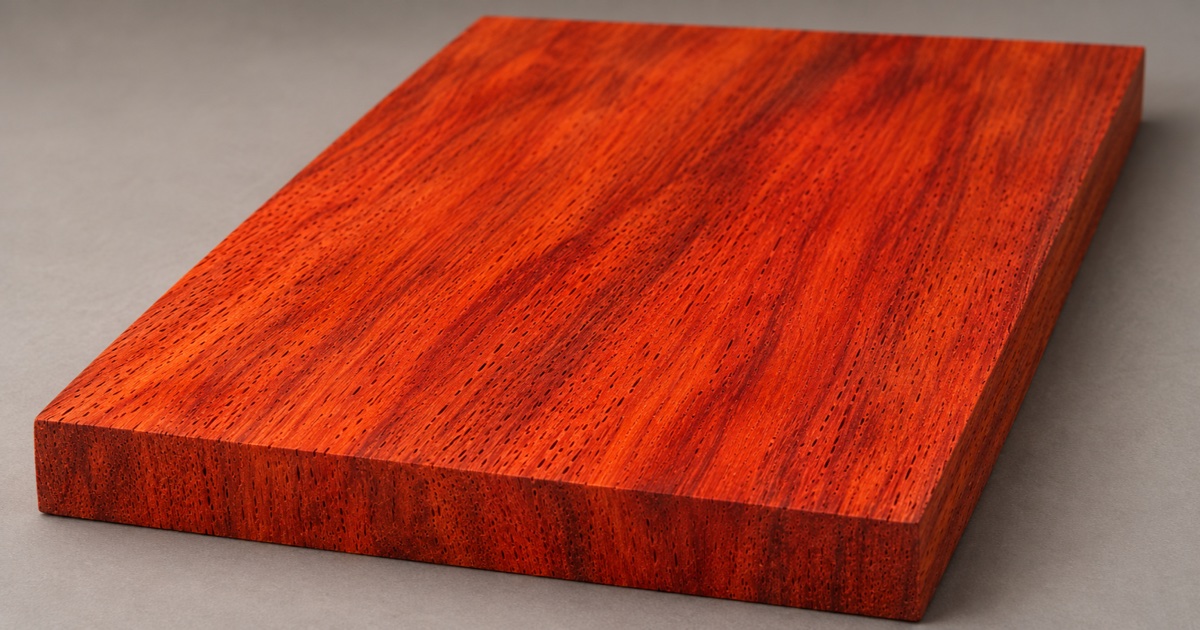
African padauk is a bright orange-red hardwood that darkens to reddish brown with age. Woodworkers use it for turnery, carving, boxes, accents, flooring and boat parts; its dust is strongly coloured and stains skin and clothing.
Health hazards
-
Asthma / respiratory allergy
Evidence: Confirmed in clinical testing
A worker developed occupational asthma from padauk dust, confirmed by a specific inhalation challenge that also caused a marked rise in eosinophils (allergy-type white cells) in the airway.1
- Effects
- occupational asthma, eosinophilic airway inflammation
- Exposure route
- inhalation
- From
- dust
-
Skin allergy
Evidence: Confirmed in clinical testing
A woodworker reacting to several exotic woods had a strong positive patch test to padauk sawdust, and an occupational allergic skin rash from Pterocarpus soyauxii has also been reported.23
- Effects
- allergic contact dermatitis
- Exposure route
- skin
- From
- dust
-
Eye irritation
Evidence: Listed by an agency
The UK HSE lists padauk as a reported cause of itching, eye irritation and swelling such as puffy eyelids, noting that effects depend on the species.4
- Effects
- itching, eye irritation, eyelid swelling
- Exposure route
- eyes, skin
- From
- dust
-
Whole-body (systemic) effects
Evidence: Listed by an agency
The UK HSE also lists vomiting among reported effects of padauk, again noting that it varies by species.4
- Effects
- vomiting
- Exposure route
- inhalation
- From
- dust
-
Cancer
Evidence: Applies to all wood dust
All wood dust is classified as carcinogenic to humans, mainly linked to cancers of the nose and sinuses after long-term exposure. This applies to this wood like any other.5
- Effects
- nasal and sinus cancer
- Exposure route
- inhalation
- From
- dust
Not finding a hazard listed here does not mean this wood is safe. All wood dust is hazardous; see how to protect yourself.
Exposure limits
| Body | Limit | Notes |
|---|---|---|
| ACGIH TLV | 1 mg/m³ (inhalable) | Applies to wood dust generally; this species has no separate ACGIH value. source |
| EU binding limit (hardwood) | 2 mg/m³ | Applies to all hardwood dust |
| UK WEL (hardwood) | 3 mg/m³ | Applies to all hardwood dust |
| NIOSH REL | 1 mg/m³ | Recommended limit for all wood dust |
Cancer classifications
- ACGIH: A4 source
Sources
- Doyen V, Kespohl S, Sohy C, Jadot I, Rifflart C, Thimpont J, de Lovinfosse S, Raulf M, Vandenplas O. Eosinophilic occupational asthma caused by padauk wood dust. J Allergy Clin Immunol Pract. 2023;11(10):3240-3241.e1. Link
- Rackett SC, Zug KA. Contact dermatitis to multiple exotic woods. Am J Contact Dermat. 1997;8(2):114-117. Link
- Kiec-Swierczynska M, Krecisz B, Swierczynska-Machura D, Palczynski C. Occupational allergic contact dermatitis caused by padauk wood (Pterocarpus soyauxii Taub.). Contact Dermatitis. 2004;50(6):384-385. Link
- Health and Safety Executive. Toxic woods. Woodworking Information Sheet No 30 (Revision 1), WIS30(rev1). HSE; first published 11/2012. Withdrawn from hse.gov.uk (404 since c. Jan 2020); archived copy cited. Link
- IARC Working Group on the Evaluation of Carcinogenic Risks to Humans. Wood Dust and Formaldehyde. IARC Monographs on the Evaluation of Carcinogenic Risks to Humans, Vol. 62. Lyon: International Agency for Research on Cancer; 1995. Link
- US Occupational Safety and Health Administration. Occupational Chemical Database: Wood Dust. Last updated 06/23/2023. Link
Last reviewed .