Redwood
Sequoia sempervirens · Cupressaceae · softwood
Also known as: California redwood, coast redwood, sequoia
Region: Coastal northern California and southern Oregon, USA
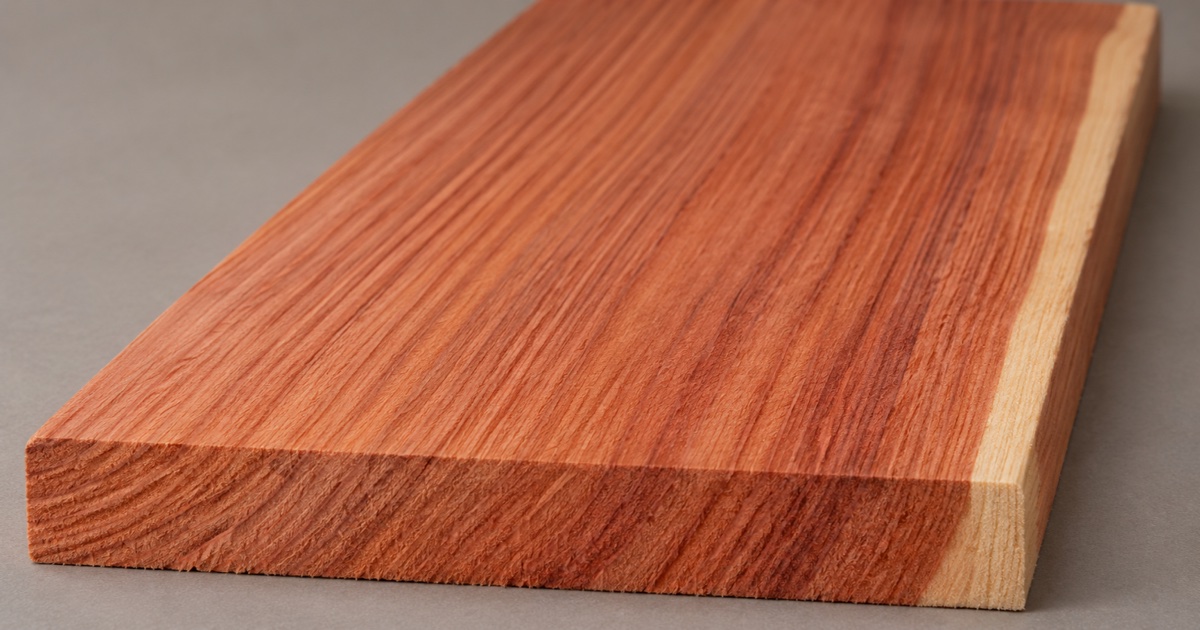
Coast redwood is a light, reddish, decay-resistant softwood from coastal California and Oregon. It is used for decking, siding, outdoor furniture, planters, and burl veneer and turning stock.
Health hazards
-
Cancer
Evidence: Applies to all wood dust
IARC classifies all wood dust as carcinogenic to humans, mainly linked to cancer of the nasal cavity and sinuses after long-term heavy exposure. This applies to every species, so dust control matters whatever you cut.1
- Effects
- nasal and sinus cancer
- Exposure route
- inhalation
- From
- dust
-
Asthma / respiratory allergy
Evidence: Confirmed in clinical testing
Three workers have been reported with asthma from redwood sawdust, each confirmed by an exposure or inhalation challenge test. The cause is thought to be small chemical compounds in the wood.23
- Effects
- occupational asthma
- Exposure route
- inhalation
- From
- dust
-
Hypersensitivity pneumonitis
Evidence: Reported
'Sequoiosis' is a lung inflammation described in 1967 in people who breathed redwood sawdust. It is often attributed to molds growing on moldy redwood dust rather than the wood itself, but we could not confirm that from the original abstract.4
- Effects
- sequoiosis, granulomatous pneumonitis
- Exposure route
- inhalation
- From
- dust
Not finding a hazard listed here does not mean this wood is safe. All wood dust is hazardous; see how to protect yourself.
Exposure limits
| Body | Limit | Notes |
|---|---|---|
| ACGIH TLV | 1 mg/m³ (inhalable) | 8-hour time-weighted average, as restated by OSHA source |
| UK WEL (softwood) | 5 mg/m³ | Applies to all softwood dust |
| NIOSH REL | 1 mg/m³ | Recommended limit for all wood dust |
Cancer classifications
- ACGIH: A4 source
Sources
- IARC Working Group on the Evaluation of Carcinogenic Risks to Humans. Wood Dust and Formaldehyde. IARC Monographs on the Evaluation of Carcinogenic Risks to Humans, Vol. 62. Lyon: International Agency for Research on Cancer; 1995. Link
- Chan-Yeung M, Abboud R. Occupational asthma due to California red wood (Sequoia sempervirens) dusts. Am Rev Respir Dis. 1976;114(5):1027-31. Link
- doPico GA. Asthma due to dust from redwood (Sequoia sempervirens). Chest. 1978;73(3):424-5. Link
- Cohen HI, Merigan TC, Kosek JC, Eldridge F. Sequoiosis. A granulomatous pneumonitis associated with redwood sawdust inhalation. Am J Med. 1967;43(5):785-94. Link
- US Occupational Safety and Health Administration. Occupational Chemical Database: Wood Dust. Last updated 06/23/2023. Link
Last reviewed .