Rosewood
Dalbergia spp. · Fabaceae · hardwood
Also known as: East Indian rosewood, Indian rosewood, sonokeling, palisander, African blackwood, Honduras rosewood
Region: Tropical regions worldwide (Central and South America, Africa, Madagascar, South and Southeast Asia)
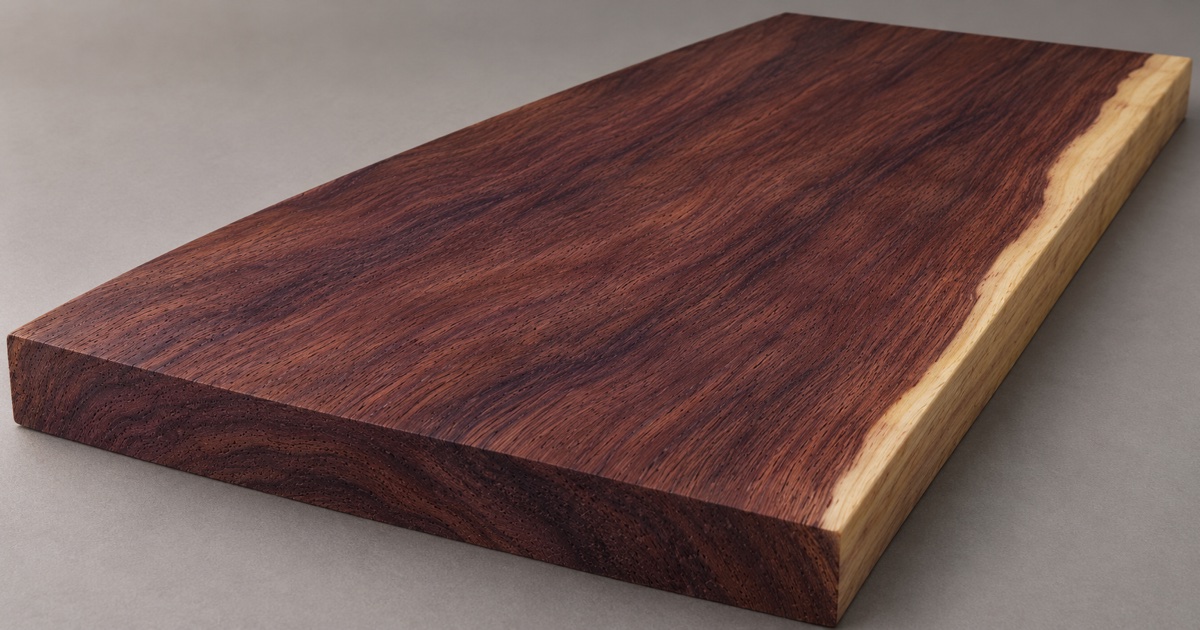
True rosewoods are the Dalbergia genus, dense and often oily hardwoods used for guitar fretboards and backs, woodwind instruments, furniture, turnery and inlay. Common woodworking species include East Indian rosewood (D. latifolia), Brazilian rosewood (D. nigra), cocobolo (D. retusa) and African blackwood (D. melanoxylon); the trade name 'rosewood' is also applied to many non-Dalbergia woods.
Health hazards
-
Skin allergy
Evidence: Confirmed in clinical testing
Patch testing has confirmed allergic skin reactions to rosewood in musicians and instrument makers, with dust-borne rashes in the makers and cross-reactions between different Dalbergia woods. Case reports for East Indian rosewood (D. latifolia) describe hand dermatitis in a wood turner and airborne dermatitis from its dust.12345
- Effects
- allergic contact dermatitis, airborne contact dermatitis, cheilitis
- Exposure route
- skin, inhalation
- From
- dust, heartwood
-
Skin allergy
Evidence: Listed by an agency
The UK HSE lists rosewoods (many species) as a reported cause of dermatitis, noting that effects can arise just from handling the wood.6
- Effects
- dermatitis
- Exposure route
- skin
- From
- dust, heartwood
-
Respiratory irritation
Evidence: Listed by an agency
The UK HSE also lists rosewoods (many species) as a reported cause of respiratory disorders, without naming a specific mechanism.6
- Effects
- respiratory disorders
- Exposure route
- inhalation
- From
- dust
-
Asthma / respiratory allergy
Evidence: Confirmed in clinical testing
Occupational asthma confirmed by inhalation challenge has been reported for Brazilian rosewood (D. nigra), and respiratory allergy for cocobolo (D. retusa). Evidence for other rosewoods is not established.78
- Effects
- occupational asthma, rhinitis
- Exposure route
- inhalation
- From
- dust
-
Cancer
Evidence: Applies to all wood dust
All wood dust is classified as carcinogenic to humans, mainly linked to cancers of the nose and sinuses after long-term exposure. This applies to this wood like any other.9
- Effects
- nasal and sinus cancer
- Exposure route
- inhalation
- From
- dust
Not finding a hazard listed here does not mean this wood is safe. All wood dust is hazardous; see how to protect yourself.
Exposure limits
| Body | Limit | Notes |
|---|---|---|
| ACGIH TLV | 1 mg/m³ (inhalable) | Applies to wood dust generally; this species has no separate ACGIH value. source |
| EU binding limit (hardwood) | 2 mg/m³ | Applies to all hardwood dust |
| UK WEL (hardwood) | 3 mg/m³ | Applies to all hardwood dust |
| NIOSH REL | 1 mg/m³ | Recommended limit for all wood dust |
Cancer classifications
- ACGIH: A4 source
Known compounds
- dalbergiones (e.g. 4-methoxydalbergione): quinone allergens shared across Dalbergia woods, thought to explain cross-reactions source
Sources
- Pfohler C, Tilgen W. Contact dermatitis of the lips due to late-type sensitization against dalbergiones in a wooden recorder. Allergol Select. 2018;2(1):29-31. Link
- Gamboa PM, Sanchez de Vicente J, Segurola A, Galan C, Escalera LMP, Arrien A, Jauregui I. Allergic contact dermatitis to woods of the genus Dalbergia in musical instruments. Contact Dermatitis. 2024;91(4):317-320. Link
- Piletta PA, Hausen BM, Pasche-Koo F, French LE, Saurat JH, Hauser C. Allergic contact dermatitis to East Indian rosewood (Dalbergia latifolia Roxb.). J Am Acad Dermatol. 1996;34(2 Pt 1):298-300. Link
- Gallo R, Guarrera M, Hausen BM. Airborne contact dermatitis from East Indian rosewood (Dalbergia latifolia Roxb.). Contact Dermatitis. 1996;35(1):60-61. Link
- Athavale PN, Shum KW, Gasson P, Gawkrodger DJ. Occupational hand dermatitis in a wood turner due to rosewood (Dalbergia latifolia). Contact Dermatitis. 2003;48(6):345-346. Link
- Health and Safety Executive. Toxic woods. Woodworking Information Sheet No 30 (Revision 1), WIS30(rev1). HSE; first published 11/2012. Withdrawn from hse.gov.uk (404 since c. Jan 2020); archived copy cited. Link
- Godnic-Cvar J, Gomzi M. Case report of occupational asthma due to palisander wood dust and bronchoprovocation challenge by inhalation of pure wood dust from a capsule. Am J Ind Med. 1990;18(5):541-545. Link
- Eaton KK. Respiratory allergy to exotic wood dust. Clin Allergy. 1973;3(3):307-310. Link
- IARC Working Group on the Evaluation of Carcinogenic Risks to Humans. Wood Dust and Formaldehyde. IARC Monographs on the Evaluation of Carcinogenic Risks to Humans, Vol. 62. Lyon: International Agency for Research on Cancer; 1995. Link
- US Occupational Safety and Health Administration. Occupational Chemical Database: Wood Dust. Last updated 06/23/2023. Link
Last reviewed .