Western red cedar
Thuja plicata · Cupressaceae · softwood
Also known as: red cedar, WRC, giant arborvitae, Pacific red cedar, British Columbia cedar
Region: Pacific Northwest, North America
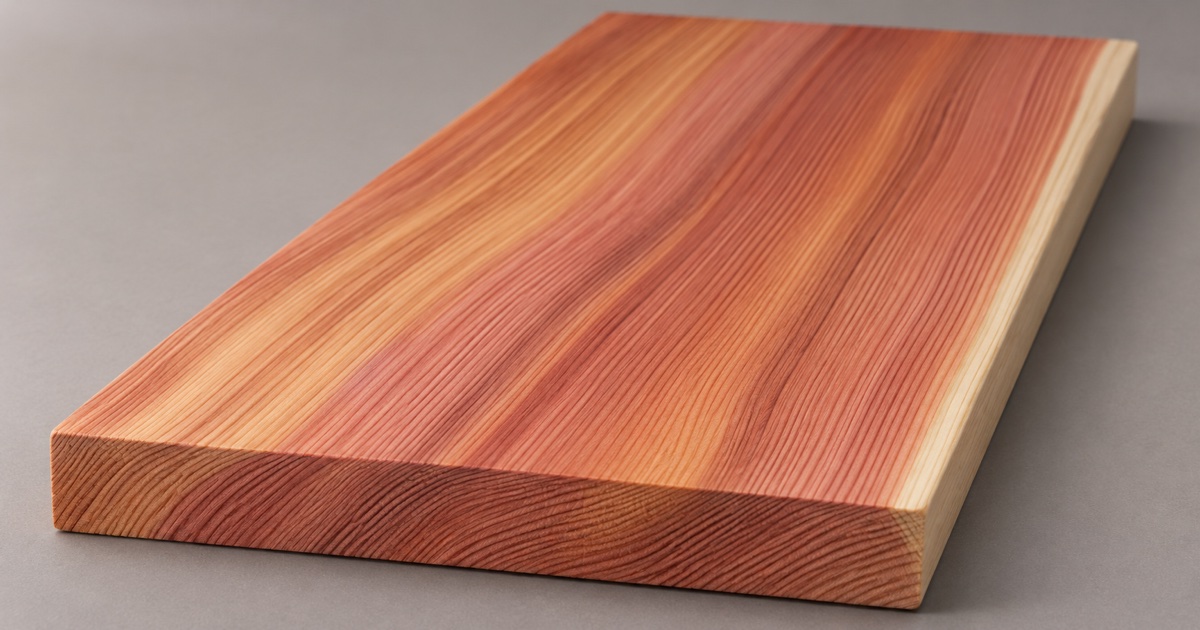
Western red cedar is a light, aromatic, rot-resistant softwood from the Pacific Northwest. It is widely used for shingles, siding, decking, fencing, outdoor furniture, sauna panelling, and boats.
Health hazards
-
Cancer
Evidence: Applies to all wood dust
IARC classifies all wood dust as carcinogenic to humans, mainly linked to cancer of the nasal cavity and sinuses after long-term heavy exposure. This applies to every species, so dust control matters whatever you cut.1
- Effects
- nasal and sinus cancer
- Exposure route
- inhalation
- From
- dust
-
Asthma / respiratory allergy
Evidence: Confirmed in clinical testing
Western red cedar is one of the best-documented causes of wood-dust asthma, confirmed by inhalation challenge in hundreds of British Columbia workers and linked to plicatic acid. Many people kept having asthma after they stopped working with it, and ACGIH flags it as a respiratory sensitizer.23456
- Effects
- occupational asthma, rhinitis
- Exposure route
- inhalation
- From
- dust
-
Skin allergy
Evidence: Confirmed in clinical testing
Patch testing confirmed allergic contact dermatitis from western red cedar sauna panelling in three Finnish cases, and ACGIH flags it as a skin sensitizer. The UK HSE also lists dermatitis.756
- Effects
- allergic contact dermatitis
- Exposure route
- skin
- From
- dust, heartwood
-
Respiratory irritation
Evidence: Listed by an agency
The UK HSE lists irritation of the nose, throat, and eyes (mucous membranes) for western red cedar dust.6
- Effects
- mucous membrane irritation
- Exposure route
- inhalation
- From
- dust
-
Whole-body (systemic) effects
Evidence: Listed by an agency
The UK HSE lists central nervous system effects for western red cedar without further detail. We did not find a primary report describing this.6
- Effects
- central nervous system effects
- Exposure route
- inhalation
Not finding a hazard listed here does not mean this wood is safe. All wood dust is hazardous; see how to protect yourself.
Exposure limits
| Body | Limit | Notes |
|---|---|---|
| ACGIH TLV | 0.5 mg/m³ (inhalable) | 8-hour time-weighted average, as restated by OSHA source |
| UK WEL (softwood) | 5 mg/m³ | Applies to all softwood dust |
| NIOSH REL | 1 mg/m³ | Recommended limit for all wood dust |
Cancer classifications
- ACGIH: A4 source
Known compounds
- plicatic acid: main cause of red cedar asthma source
Sources
- IARC Working Group on the Evaluation of Carcinogenic Risks to Humans. Wood Dust and Formaldehyde. IARC Monographs on the Evaluation of Carcinogenic Risks to Humans, Vol. 62. Lyon: International Agency for Research on Cancer; 1995. Link
- Chan-Yeung M, Barton GM, MacLean L, Grzybowski S. Occupational asthma and rhinitis due to Western red cedar (Thuja plicata). Am Rev Respir Dis. 1973;108(5):1094-102. Link
- Chan-Yeung M, Lam S, Koener S. Clinical features and natural history of occupational asthma due to western red cedar (Thuja plicata). Am J Med. 1982;72(3):411-5. Link
- Chan-Yeung M, MacLean L, Paggiaro PL. Follow-up study of 232 patients with occupational asthma caused by western red cedar (Thuja plicata). J Allergy Clin Immunol. 1987;79(5):792-6. Link
- US Occupational Safety and Health Administration. Occupational Chemical Database: Wood Dust. Last updated 06/23/2023. Link
- Health and Safety Executive. Toxic woods. Woodworking Information Sheet No 30 (Revision 1), WIS30(rev1). HSE; first published 11/2012. Withdrawn from hse.gov.uk (404 since c. Jan 2020); archived copy cited. Link
- Huilaja L, Kubin ME, Riekki R. Contact allergy to finished woods in furniture and furnishings: a small allergic contact dermatitis epidemic to western red cedar in sauna interior decoration. J Eur Acad Dermatol Venereol. 2016;30(1):57-9. Link
- Cartier A, Chan H, Malo JL, Pineau L, Tse KS, Chan-Yeung M. Occupational asthma caused by eastern white cedar (Thuja occidentalis) with demonstration that plicatic acid is present in this wood dust and is the causal agent. J Allergy Clin Immunol. 1986;77(4):639-45. Link
Last reviewed .